
- Overview
- Case Examples
- Differential diagnosis (acute phase)
- Differential diagnosis (chronic phase)
- References
Overview
Leber hereditary optic neuropathy (LHON) is a hereditary condition causing severe bilateral vision loss with most progressing to a visual acuity of 6/60 (20/200) or worse. It is caused by mutations in the mitochondrial DNA which leads to axonal swelling in the acute stage, and axonal death in the latter stage.
The acute phase of LHON presents with acute, painless loss of central vision in one eye with the second eye typically becoming involved 6-8 weeks later. Clinical signs at presentation include optic disc hyperemia, vascular tortuosity, peripapillary telangiectatic vessels and swelling of the peripapillary RNFL. However, the fundus may appear normal in 20-40% of cases.
As the acute phase subsides (approximately 6 weeks), the disc hyperaemia, peripapillary telangiectasia and oedema resolve. Atrophy of the RNFL can subsequently follow, confined to the papillomacular bundle in most cases.
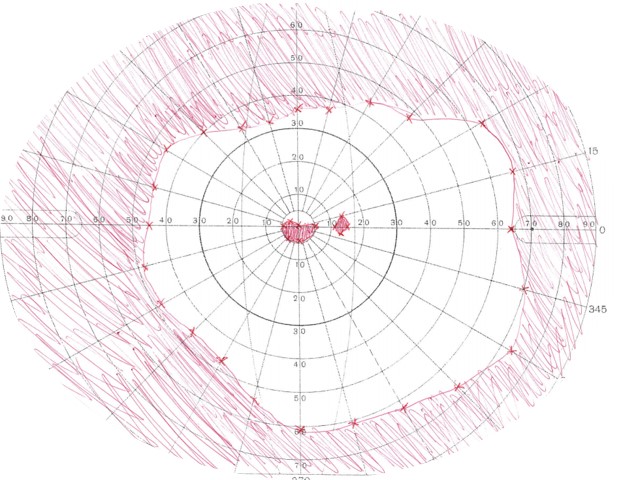
Visual field test may show central or centrocecal scotomas.
Case Examples
-
Case 1: Chronic LHON
A 53 year old Caucasian male who was diagnosed with LHON 25 years previously. His visual acuity is measured as finger counting at 2m (6 feet) which he achieves using eccentric viewing. His brother and three cousins have all been diagnosed with the same condition.
Colour vision testing with the standard D-15 showed multiple crossings along the deutan/protan axis.
Fundus photos and red free images (right and left optic disc)
More infoRed free posterior pole images (right and left eye)
More infoSpectralis OCT macula line scans (right and left eye)
More infoCirrus RNFL Analysis
More infoCirrus Ganglion Cell analysis
More infoCirrus Macula Thickness map
More infoGoldmann kinetic perimetry (size III stimulus)
More infoElectroretinogram (ERG) - standard
More infoPattern ERG
More info
Differential diagnosis (acute phase)
Differential diagnosis (chronic phase)
References
Man PYW, Turnbull DM, Chinnery PF (2002) Leber hereditary optic neuropathyJournal of Medical Genetics 39:162-169.
Meyerson, C., Van Stavern, G., & McClelland, C. (2015). Leber hereditary optic neuropathy: current perspectives. Clinical ophthalmology (Auckland, N.Z.), 9, 1165–1176.