
Overview
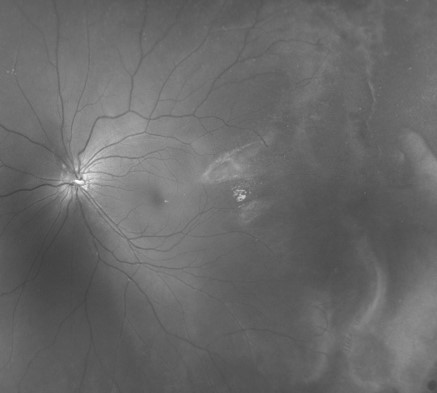
Familial exudative vitreoretinopathy (FEVR) is a hereditary condition, typically caused by mutations in the NDP, FZD4, LRP5, and TSPAN12 genes. Various inheritance patterns are possible, including X-linked recessive, autosomal dominant, and autosomal recessive patterns.
The condition is characterised by avascularity of the peripheral retina. This avascularity leads to retinal hypoxia and the release of VEGF with subsequent development of peripheral neovascularisation. This in turn leads to macular dragging and tractional retinal detachment. Subretinal exudation may also occur.
This condition has many similar features to retinopathy of prematurity and is most easily distinguished by a lack of history of prematurity.
Case Example
-
Case 1
An 11 year old Asian male with unremarkable medical and birth history. His best corrected visual acuity is 6/9.5+ (20/32) in the right eye and 6/7.5- (20/25) in the left eye.
Fundus photograph and red-free image (right eye)
More infoFundus photograph and red-free image (left eye)
More infoSterophoto of right optic disc
More infoSterophoto of left optic disc
More infoOptomap wide field image (right eye)
More infoOptomap wide field image (left eye)
More infoOptomap green separation image (right eye)
More infoOptomap green separation image (left eye)
More infoSpectralis OCT line scan of right (1) and left (2) optic discs
More infoSpectralis OCT volume scan (left mid-peripheral temporal retina)
More infoSpectralis OCT line scans - left mid-peripheral temporal retina (1), left supero-temporal retina (2)
More infoSpectralis OCT line scans (left infero-temporal retina)
More info
Differential Diagnosis
References
Gilmour, D. (2015) Familial exudative vitreoretinopathy and related retinopathies. Eye 29, 1–14
Ranchod, TM, Ho, LY, Drenser, KA, Capone, A. Trese,M. (2011) Clinical Presentation of Familial Exudative Vitreoretinopathy, Ophthalmology,Volume 118, Issue 10 Pages 2070-2075,