
Overview
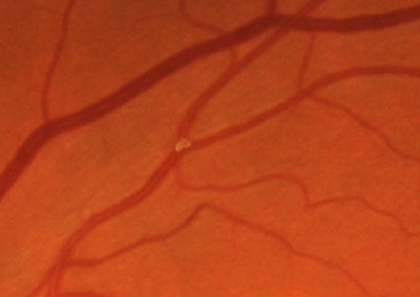
Emboli are materials from endogenous or exogenous sources that cause arterial occlusion, most commonly at a bifurcation of the artery - a point at which the arterial lumen reduces making it a likely place for solid substances moving through the arteries to lodge.
In order to cause arterial occlusion, the embolus must completely block the flow of blood through the artery.
There are several types of emboli:
1. Cholesterol (commonly referred to as a Hollenhorst plaque). These emboli are orange-yellow in appearance and often found some distance from the optic disc.
2. Calcific: These emboli typically originate from calcified cardiac valves, particularly in calcific aortic valve stenosis. They are whiter in colour and highly refractile. They are typically associated with occlusion of larger retinal arteries and found closer to the optic disc.
3. Platelet-fibrin emboli: These are typically dull-grey in colour and elongated in appearance.
Rare causes include: talc emboli (IV drug users), fat emboli (bone fractures), septic emboli (infective endocarditis) as well as trauma, sickle cell disease, pregnancy, infection, inflammation, connective tissue disorders or oral contraceptives
Case Examples
References
Cho,KH, Ahn,SJ, Cho,JH, Jung,C, Han,MK, Park, SJ, Park,KH, Woo, SJ. (2016) The Characteristics of Retinal Emboli and its Association With Vascular Reperfusion in Retinal Artery Occlusion. Invest. Ophthalmol. Vis. Sci. 57(11):4589-4598.