
Overview
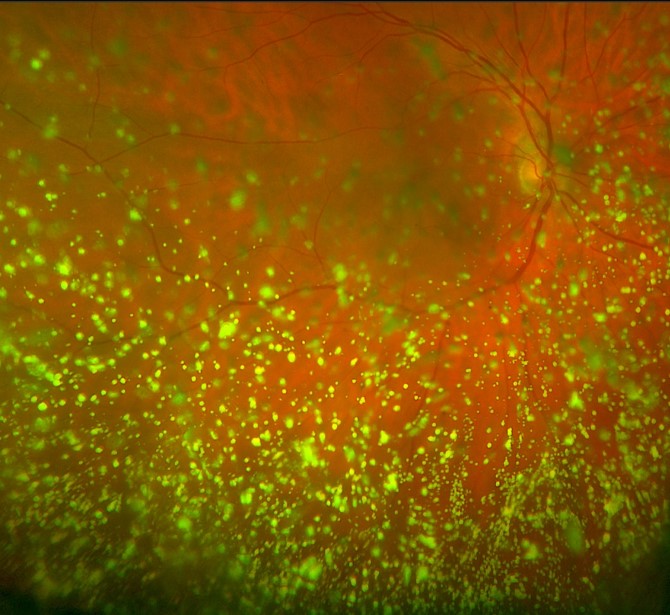
Spherical yellow-white particles (asteroid bodies), consisting of calcium and phosphates, in the vitreous of the eye. The particles have a very minor impact on vision in most cases, rarely reducing visual acuity. The presence of widespread asteroid hyalosis however may make retinal examination challenging and following a vitreous detachment may coalesce behind the lens causing a reduction in vision.
Prevalence of asteroid hyalosis is approximately 1% (Australian Blue Mountains Eye Study).
Asteroid hyalosis can usually be seen on slit lamp examination (or with the naked eye). On posterior imaging, dot-like reflective opacities can be seen within the vitreous – appearing as relatively green on Optomap widefield imaging due to their anterior position relative to the retina. The particles are suspended in the vitreous, moving along with the movement of the vitreous body and returning to their previous position after the movement stops.
B-scan ultrasound shows mobile hyperacoustic signals densely distributed through the vitreous.
Case Examples
Differential Diagnoses
Differential diagnoses include amyloidosis, vitritis and synchysis scintillans.
References
Khoshnevis M. et al. Asteroid hyalosis—a comprehensive review. Survey of Ophthalmology 2019 64; 4: 452-462