
- General Information
- Gonioscopic Features
- Gonioscopy Techniques
- Gonioscopic Anomalies
- Morphological Iris Variations
- Related Topics
- Other glaucoma assessment topics
- References
General Information
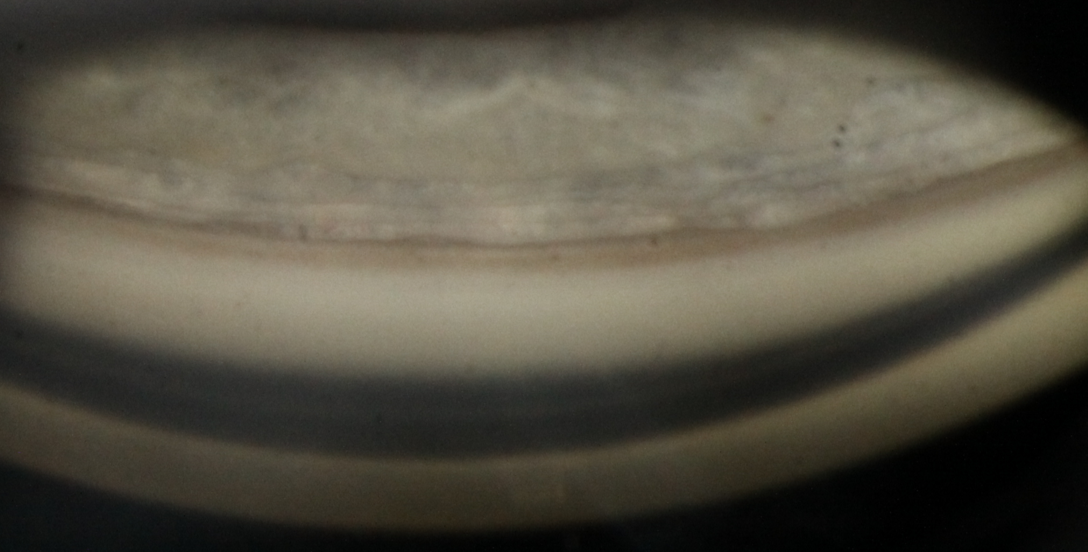
Examination of the anterior chamber angle is a critical part of the eye examination, particularly in glaucoma. Gonioscopy remains the gold standard technique for visualising the angle anatomy, assessing for secondary risk factors for glaucoma and diagnosing angle closure.
Clinicians need to learn how to perform gonioscopy and also identify the features they are viewing. This page aims to illustrate key gonioscopy landmarks and abnormalities to help develop this understanding.
Gonioscopy allows visualisation of the anterior chamber angle indirectly. In other words, the superior angle is imaged in the inferior mirror. As a result the image is rotated 180 degrees, so the image shown here is actually of the superior angle.
Gonioscopic Features
-
Landmarks
The key gonioscopic landmarks are illustrated below.
-
Anatomical Relationship
Understanding the anatomy of what you are visualising on gonioscopy is necessary when assessing the anterior chamber angle.
Gonioscopy Techniques
-
Lens Tilt
In a narrow angle, it is important to perform gonioscopy both in primary gaze and with lens tilt or off-axis viewing. If the posterior trabecular meshwork is not visible in primary gaze, tilting the lens or asking the patient to look off-axis may reveal additional structures.
Lens tilt allows to see 'over the hill' of the iris contour. If additional structures can be seen with lens tilt, this suggests a steep iris contour (such as plateau iris configuration - described below). However, if no further structures can be seen, this strongly suggests the presence of iridotrabecular contact.
-
Indentation Gonioscopy
In patients where there are no angle structures visible, indentation gonioscopy can yield additional clinical information.
By applying direct pressure to the eye, if the angle opens up (i.e. more structures become visible), this indicates an absence of synechiael/adhesion related closure. If the angle remains closed, this suggests synechiae or attachments are present.
Gonioscopic Anomalies
-
Peripheral Anterior Synechiae
Peripheral anterior synechiae are adhesions of the iris to the anterior chamber angle
-
Angle Recession
Angle recession refers to a separation of the longitudinal and circular fibres of the ciliary body. It is a common sequelae of blunt ocular trauma.
Clinically, angle recession is characterised by a focal widening of the ciliary body band on gonioscopy. Increased trabecular meshwork pigmentation is typically associated with this presentation and anterior OCT shows a posterior displacement of the iris profile.
-
Blood in Schlemm's Canal
Schlemm's canal is not visible unless there is blood. Blood in Schlemm's canal can be caused by increased intraocular pressure, increased episcleral venous pressure (possibly from a goniolens), hyphema, neovascularisation of the angle or several other (rarer) factors.
-
Prominent Greater Arterial Circle of the Iris
The major arterial circle of the iris can be more prominent in light coloured irides.
-
Angle Neovascularisation
Iris neovascularisation typically appears as a fine network of vessels at the pupillary margin. These blood vessels can extend towards the anterior chamber angle and can be viewed on gonioscopy.
-
Increased pigmentation of the trabecular meshwork
Increased pigmentation of the trabecular meshwork may arise from pigment dispersion syndrome (PDS), pseudoexfoliation syndrome (PXF), ocular trauma and/or surgery. The amount of pigmentation may vary in PDS and PXF, depending on the stage of the disease.
PXF and PDS may also be associated with deposition of pigment along or anterior to Schwalbe's line. This finding is termed Sampaolesi’s line.
More information about each of these conditions may be found on the links provided at the bottom of the page.
-
Iris/Iridociliary Cyst
An iris cyst appears as a focal elevation of the iris on slit lamp biomicroscopy and gonioscopy. From this information alone, an iris lesion should be suspected however the nature of this lesion can be determined through further anterior eye imaging.
Anterior OCT can confirm elevation of the lesion however signal transmission is blocked by the iris pigment epithelium so the internal characteristics of the lesion can not be determined.
The ultrasound biomicroscopy (UBM) signal can penetrate the iris pigment epithelium, and in the case of an iris cyst, can be used to show the lesion to be acoustically hollow.
-
Iris Naevus
Peripheral iris naevi may appear on gonioscopy. Pigmentation may be variable. These lesions are differentiated from iris cysts using ultrasound biomicroscopy - the lesions show an internal hyperechoic signal, indicating a solid lesion (iris naevus or melanoma), rather than an acoustically hollow lesion (iris cyst).
Morphological Iris Variations
-
Typical Iris Configuration
The iris typically has a slightly convex shape and should not contact the cornea
-
Plateau Iris Configuration
The term "plateau iris configuration" refers to an iris that is anteriorly-bowed. This configuration is best appreciated on anterior OCT. This morphological variation occurs when the root of the iris is short and it is anteriorly inserted on the surface of the ciliary body.
You can note from the example below that there is a flat iris plane with a steep iris insertion. The central anterior chamber depth is normal with this configuration however the anterior chamber angle appears narrow.
A plateau iris configuration can cause obscuration of more posterior angle structures on gonioscopy, and lens tilt is required to assess the deepest structure.
Plateau iris configuration may be associated with angle closure glaucoma as the peripheral iris may contact the trabecular meshwork (plateau iris syndrome). More information is available on the link below.
-
Posteriorly bowed Iris
A posteriorly bowed iris (concave iris) has been associated with pigment dispersion syndrome and the iris shape is thought to be a significant contributing factor to this condition (further information provided in link below).
Accommodation also causes a posterior bowing of the iris. This is believed to be due to a temporary reduction in anterior chamber volume due to the forward movement of the accommodating lens. Volume reduction causes an increase in anterior chamber pressure which then pushes the iris backwards.
Other glaucoma assessment topics
References
Ng DS, Ching RH, Chan CW. Angle-recession glaucoma: long-term clinical outcomes over a 10-year period in traumatic microhyphema. Int Ophthalmol. 2015 Feb;35(1):107-13.
Shuba L, Nicolela MT, Rafuse PE. Correlation of capsular pseudoexfoliation material and iridocorneal angle pigment with the severity of pseudoexfoliation glaucoma. J Glaucoma 2007;16:94-7
Wang, S.B., Cornish, E.E., Grigg, J.R. and McCluskey, P.J. (2019), Anterior segment optical coherence tomography and its clinical applications. Clin Exp Optom, 102: 195-207.
Yim-lui Cheung,C. Shu Liu, RN. Weinreb, JL. Haitao, L. Dexter, Leung, YL, Dorairaj,S. Liebmann,J. Ritch,J. Lam,DSC. Kai-shun Leung,C. (2010) Dynamic Analysis of Iris Configuration with Anterior Segment Optical Coherence Tomography. Invest. Ophthalmol. Vis. Sci. 2010;51(8):4040-4046