
Overview
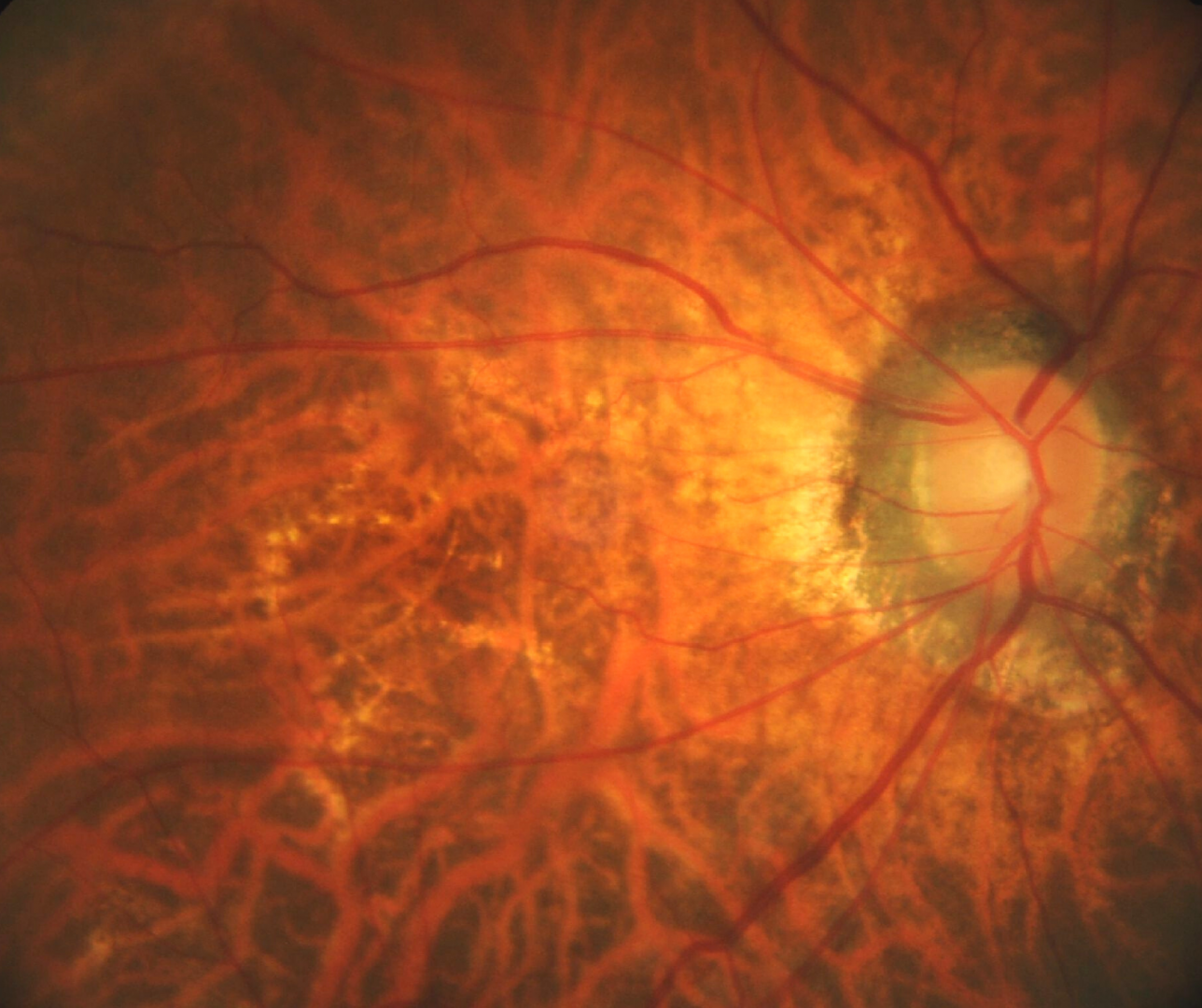
High myopia is typically defined as a refractive error greater than -6.00DS with definitions also often incorporating an axial length measurement component of greated than 26mm. It is characterised by increased axial length and/or the presence of a posterior staphyloma. The elongation of the globe can lead to a plethora of changes in the eye, and is one of the major causes of vision impairment and the term pathological myopia.
Ruiz-Medrano et al (2019) proposed categorising the spectrum of myopic maculopathy into atrophic, tractional and neovascular components.
Tractional changes are brought about by a change in the globe morphology and include myopic foveoschisis, foveal detachment, inner limiting membrane (ILM) detachment, myopic holes and paravascular tractional changes.
Atrophic changes can be either diffuse or patchy in nature and may lead to neovascular changes.
This section will explore each of these components through the exploration of case examples.
Sub-Topics
Posterior staphyloma
Chorioretinal atrophy
Paravascular Vitreous Attachments in Myopic Maculopathy
Myopic tractional maculopathy
Dome-shaped macula
Lacquer cracks
Myopic choroidal neovascularisation
Sub-retinal haemorrhage
Intrachoroidal cavitation
References
Ruiz-Medrano J, Montero JA, Flores-Moreno I et al. (2019) Myopic maculopathy: Current status and proposal for a new classification and grading system (ATN). Prog Ret Eye Res 69:80-115.